
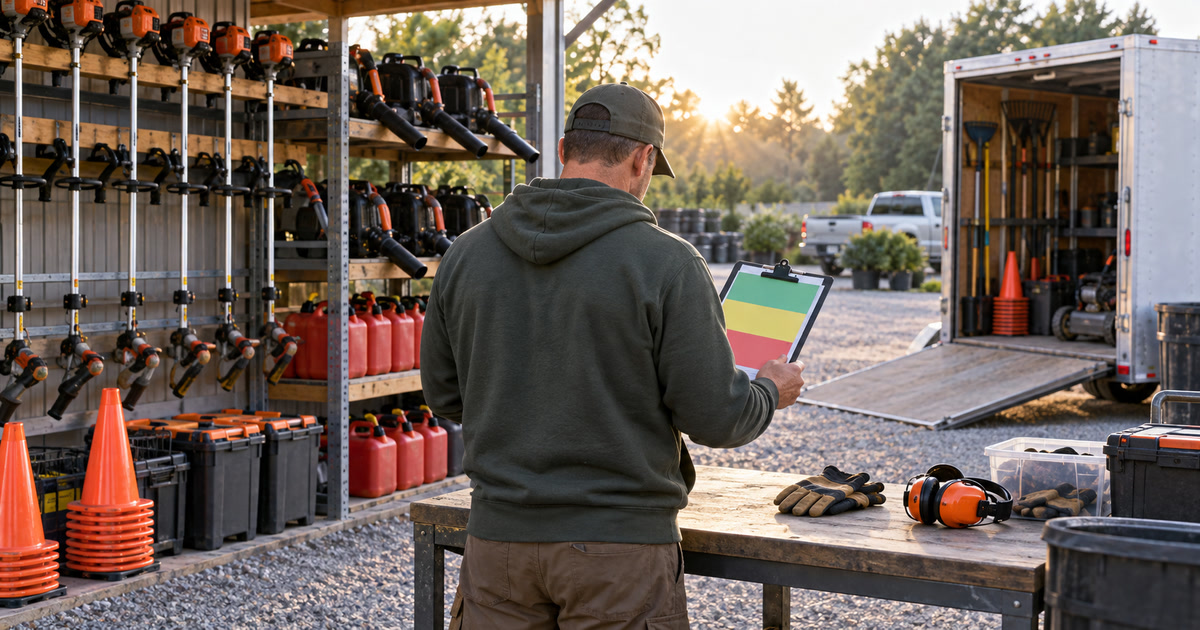
Clearly hypothetical scenario: A landscaping company reviews its emergency and continuity plans during National Preparedness Month. The documents exist, but crew leads still need to know which version is current, what applies to their role, and when a question must stop with a supervisor.
A useful knowledge agent makes approved guidance easier to find. It does not turn safety, equipment, chemical, weather, or emergency judgment into an automated answer.
Short answer: An AI agent for training and knowledge in landscaping companies can organize approved procedures, surface the right job aid for a defined question, flag missing or conflicting material, and route exceptions to a supervisor. It should not create safety rules, certify a worker, decide whether conditions are safe, choose protective equipment, interpret pesticide requirements, or replace hands-on instruction. Use it as a controlled doorway into material the company has already reviewed. Keep field observation, coaching, competency checks, emergency decisions, and technical judgment with qualified people. Preparedness improves when the team can find the right source and knows when to stop.
Why preparedness is a knowledge problem
FEMA launched National Preparedness Month 2026 on September 1 and encouraged people and organizations to make plans, know how they will receive alerts, and use practical preparedness resources.[1] Ready Business separately says business planning should include communications, IT support and recovery, and continuity. It also identifies training, testing, and exercises as essential parts of preparedness.[2]
For a landscaping or lawn-care company, the useful content lesson is narrow. A plan is not ready simply because a file exists. The people expected to use it need the current version, the right context, and a clear human owner for decisions.
That matters because landscaping work spans more than one administrative situation. OSHA’s landscaping topic page identifies potential exposure to machinery, chemicals, noise, lifting, construction, vehicles, weather, and other hazards.[3] KIGWI should not interpret those hazards or write a safety program for a contractor. A training and knowledge workflow can help the contractor control its own approved material and route questions to the people authorized to answer them.
What a training and knowledge AI agent can support
KIGWI’s public Solutions page describes the Training & Knowledge Agent as a way to make documented company knowledge available for onboarding and day-to-day questions.[5] In a landscaping company, a properly bounded workflow could support administrative tasks such as:
- indexing approved procedures, checklists, role guides, and continuity documents
- returning the source title, owner, version, and review date with each answer
- showing which document applies to a crew lead, office coordinator, driver, or equipment custodian
- identifying when two approved documents conflict or when no approved answer exists
- collecting routine acknowledgment records when the company’s process requires them
- routing safety, equipment, chemical, weather, emergency, licensing, or technical questions to a named human owner
- preserving the original question so the reviewer sees what the worker actually asked
The agent should answer from controlled material, not from a plausible guess. When a source is missing, stale, or unclear, the correct response is a stop and a handoff.
Where a person is the better choice
A human trainer or supervisor is not interchangeable with a knowledge agent.
A person is the better choice when the work requires:
- observing how someone handles equipment or performs a field task
- correcting technique in context
- judging whether a worker has understood and can apply instruction
- evaluating changing weather, site, traffic, terrain, or equipment conditions
- deciding what safety, chemical, environmental, licensing, or emergency rule applies
- coaching through an unusual situation
- taking responsibility for a stop-work, return-to-work, or emergency decision
The hiring question is therefore not “person or AI” in the abstract. It is which part of the training system is repetitive information retrieval, and which part requires observation, judgment, authority, and accountability.
| Need | Training and knowledge AI agent | Human trainer or supervisor |
|---|---|---|
| Find the current approved procedure | Useful when sources are controlled and versioned | Confirms the source and resolves conflicts |
| Answer a routine administrative question | Can return approved wording and source context | Handles ambiguity and exceptions |
| Demonstrate equipment use | Not appropriate | Required qualified instruction and observation |
| Judge field readiness | Not appropriate | Human evaluation and authority |
| Handle an emergency or safety concern | Stops and routes | Responsible person decides and acts |
| Improve weak source material | Flags gaps and repeated questions | Rewrites, approves, and owns the guidance |
Build the knowledge path before adding the agent
1. Name the source owner
Every procedure needs a person responsible for its accuracy, scope, and update decisions. A folder full of orphaned PDFs is not a knowledge system.
2. Keep role and context attached
The same question may have a different answer for an office coordinator, crew lead, driver, applicator, or subcontractor. Record who the material is for, which work it covers, where it applies, and when it expires or needs review.
OSHA’s landscape safety-program page points employers to resources for safety and health programs, Spanish-speaking workers, and youth workers.[4] That is a reminder to review language, literacy, role, and worker context with qualified owners. It is not permission for an AI agent to translate, simplify, or assign regulated guidance on its own.
3. Write refusal and handoff rules
The agent should stop when a question involves:
- immediate danger or an emergency
- equipment operation or jobsite technique
- pesticides, fertilizers, chemicals, or environmental decisions
- personal protective equipment selection
- driving, traffic control, electrical, excavation, irrigation, tree work, or other technical activity
- a missing, conflicting, or expired source
- a worker asking for a legal, medical, employment, or compliance decision
A refusal is useful only when it points to the correct human route without inventing a promise or response time.
4. Test with realistic but synthetic questions
Use fictional names and no customer, employee, property, health, credential, or incident data. Include ordinary questions, incomplete questions, conflicting sources, outdated documents, language requests, and situations where the agent must refuse. A successful answer is not enough. The team also needs to observe whether the workflow stops safely.
A practical National Preparedness Month review
A landscaping company can use the current preparedness month as a review prompt without turning it into a fear campaign. The review can ask:
- Which continuity and emergency documents are approved now?
- Who owns each source?
- Which roles need each document?
- How does the team receive current local alerts?
- Which questions require a supervisor or qualified specialist?
- What happens when a source is missing or contradictory?
- Can the team test the handoff with synthetic scenarios?
- Is there a clear pause path when the workflow behaves unexpectedly?
This review does not certify preparedness or compliance. It exposes whether the company can find, understand, test, and govern its own material.
KIGWI is a fractional AI operations team. Its role here is bounded administrative support around approved knowledge and repeatable handoffs. The landscaping company keeps authority over training content, field instruction, worker competency, safety, technical work, environmental decisions, and emergencies.
Frequently asked questions
Can a training and knowledge AI agent replace a landscaping safety trainer?
No. It can help people find approved material and route questions, but it cannot observe field technique, judge competency, correct equipment use, or own a safety decision. Qualified human trainers, supervisors, and specialists remain responsible for instruction, observation, approval, and intervention under the rules that apply to the company and work.
Can the agent answer questions about pesticides or fertilizers?
It should not select a product, application rate, protective equipment, treatment method, or legal requirement. At most, it may direct an authorized worker to the company’s current approved source and named reviewer. Missing, conflicting, chemical, environmental, certification, or application questions should stop and go to the qualified human owner.
What should the agent show with an answer?
Show the source title, owner, version or review date, intended role, and the specific approved passage used. If the source is expired, contradictory, or absent, say so and route the question. This makes the answer reviewable and keeps a confident summary from hiding weak source control.
Is National Preparedness Month proof that a landscaping company needs this agent?
No. It is a timely prompt to review preparedness, not evidence of buyer intent or a universal need. The company should first examine its actual documents, questions, handoffs, risks, and review capacity. A knowledge agent is useful only if the approved source material and human ownership are ready.
What should a landscaping company test first?
Start with a narrow set of routine, non-sensitive questions using synthetic information. Test correct source retrieval, version display, role fit, conflict detection, refusal rules, and routing. Then have the responsible people review both correct answers and safe stops before expanding the workflow or connecting it to another system.
Next step
Review KIGWI’s Training & Knowledge Agent scope. Compare it with one approved landscaping procedure set, then mark every safety, equipment, chemical, weather, emergency, licensing, and technical question for human ownership.
Sources
[1] https://www.fema.gov/press-release/20260901/fema-kicks-national-preparedness-month-2026-empowers-americans-stand-ready [2] https://www.ready.gov/business [3] https://www.osha.gov/landscaping/hazards [4] https://www.osha.gov/landscaping/safety-programs [5] https://kigwi.com/solutions