
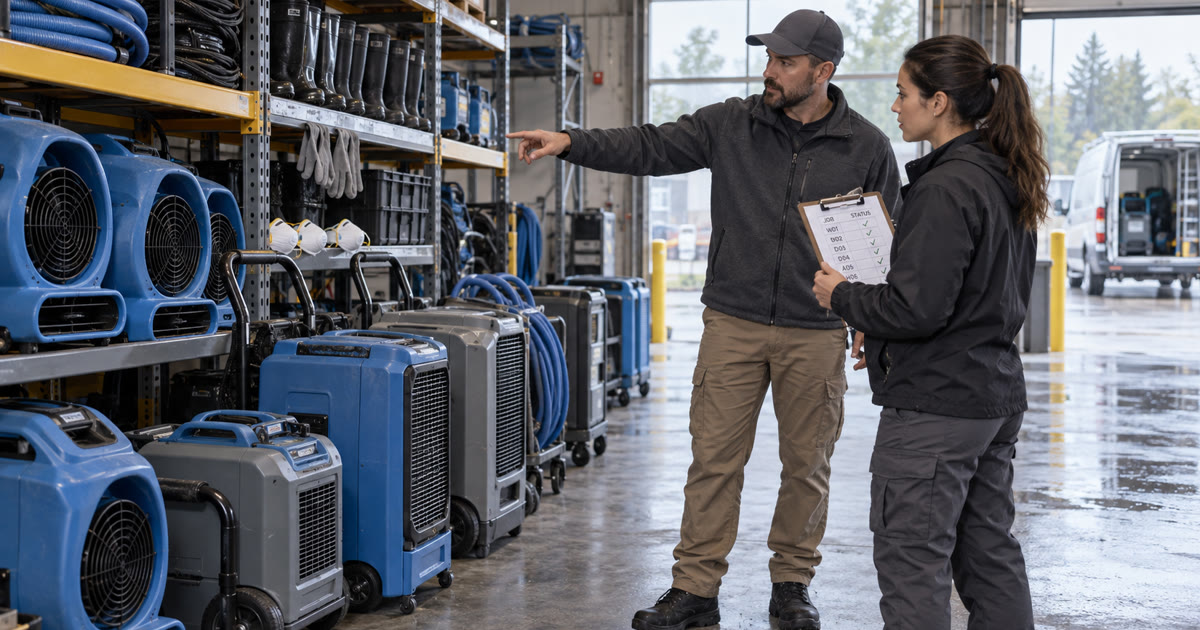
After several rounds of heavy rain, a water damage restoration company may receive several inquiries with very different facts. One caller reports water near an electrical outlet. Another has a wet ceiling. A third wants to know whether the business serves a nearby town. This is a hypothetical intake scene, not a customer story.
The first response should organize the request, not pretend to assess the loss.
Short answer: An AI agent speed-to-lead responder for water damage restoration can acknowledge a new inquiry, collect approved intake details, and route the record to the right person. It should not classify water, judge structural or electrical safety, promise arrival times, estimate a loss, interpret insurance coverage, or tell someone how to enter or clean a damaged property. A strong workflow defines the fields to collect, the conditions that stop automation, and the human role that receives each exception. The goal is a usable handoff, not an automated restoration decision.
Why this matters during the current weather season
The National Weather Service reported repeated heavy rain and significant flooding in parts of Indiana and Ohio from September 16 through September 20, 2026.[2] NOAA’s August outlook still called for a below-normal Atlantic hurricane season, but it also said the outlook is not a landfall forecast and that inland rainfall can cause major damage even when a storm does not reach hurricane strength.[3]
Those facts do not predict demand for any particular restoration company. They do support one practical planning point: local flooding and heavy rain can create an uneven intake load even when the wider seasonal outlook sounds quiet.
September is also National Preparedness Month. FEMA’s 2026 campaign encourages households and communities to make plans, receive alerts, and prepare before an emergency.[4] For a restoration business, the administrative equivalent is simple. Define the intake path before the inbox, web form, or phone queue gets crowded.
What the first response should collect
A useful first-response record can be narrow. The business may approve fields such as:
- caller name and safe callback method;
- property location and service-area check;
- the caller’s own description of where water is visible;
- when the issue was first noticed;
- whether the caller reports electricity, gas, sewage, injury, fire, collapse, or another stop condition;
- occupancy or access notes that the business actually needs;
- the correct human route for review.
The agent records what the person says. It does not translate those answers into a technical category, safety decision, work scope, claim value, or coverage conclusion.
KIGWI’s Solutions page lists responding to new inquiries, answering approved first questions, booking a meeting or call, and capturing inbound inquiries among the Speed-to-lead Responder’s functions.[1] Any water damage restoration workflow still needs verified fields, channels, business rules, privacy limits, and human owners before use.
Build stop conditions before response copy
Fast acknowledgment is easy to admire. Stop conditions are what make the workflow responsible.
A routine intake path should stop and route when the caller reports a condition that needs qualified judgment or urgent human attention. Examples can include:
- water near electrical equipment or outlets;
- sewage or potentially contaminated water;
- fire, gas, injury, collapse, or an unsafe entry concern;
- a request for cleanup or safety instructions;
- a demand for an arrival-time guarantee;
- a request for a firm price, work scope, or insurance-coverage answer;
- an upset caller, complaint, or disputed prior interaction;
- facts that do not fit the approved intake path.
CDC guidance warns that floodwater can create electrical, contamination, and injury hazards.[5] The operational lesson for an intake agent is not to repeat safety advice from memory. It is to stop, use only approved emergency language, and route the caller to the responsible person or public emergency resource defined by the business.
AI response layer, additional coordinator, or both?
The useful hiring comparison is task by task. It is not a contest between software and people.
| Intake task | AI speed-to-lead fit | Human coordinator fit |
|---|---|---|
| Acknowledge a standard new inquiry | Strong when the approved channel and wording are verified | Strong |
| Collect defined intake fields | Strong for a stable question set | Strong, especially when follow-up changes with context |
| Repeat back captured details | Strong | Strong |
| Detect a listed stop condition | Useful for flagging and routing, not deciding the risk | Required for judgment and next action |
| Handle distress, complaints, or unusual facts | Stop and route | Stronger fit |
| Promise timing, price, scope, safety, or coverage | Not appropriate | Only an authorized person with the necessary facts may decide |
| Review and improve the intake path | Can provide organized records | Human ownership required |
An additional coordinator may be the better choice when most inquiries are unusual, emotionally difficult, or dependent on changing field conditions. An AI response layer may fit when the business has a stable first question set and a dependable handoff. Some teams may use both, with the agent collecting routine information and a coordinator owning exceptions.
No content packet can decide that staffing question for a specific business. The owner needs the actual inquiry mix, current team capacity, risk tolerance, and service model.
What a usable handoff contains
A handoff should let the next person understand what happened without replaying the entire exchange.
Include:
- the caller’s contact preference and location;
- the caller’s description in their own words;
- when the issue was noticed;
- any stop condition the caller reported;
- what the agent said and did not say;
- the assigned human owner and current status;
- the next approved administrative step.
Avoid a vague label such as “urgent” unless the business has defined who may apply it and what it means. The agent can flag the exact words that triggered a route. A person decides what follows.
Test the refusal path, not only the greeting
A polished greeting tells you very little about how the workflow behaves when facts become messy. Before use, test the agent with fictional scenarios that include missing information, conflicting answers, complaints, safety concerns, off-area properties, requests for guarantees, and repeated messages.
Check whether the workflow:
- asks only approved questions;
- keeps the caller’s wording intact;
- refuses technical, safety, insurance, and pricing decisions;
- sends the record to the correct role;
- avoids duplicate records;
- shows what happened when a handoff fails.
Human review is not a fallback bolted on later. It is part of the workflow design.
Frequently asked questions
Can a speed-to-lead agent decide whether a water loss is an emergency?
No. The agent can detect a listed phrase or reported condition and route it under approved rules. A qualified person or public emergency service owns the actual safety and urgency decision. The agent should never turn incomplete intake details into a technical classification.
What details should a water damage restoration intake collect first?
Start with the minimum information needed for a safe handoff: contact method, property location, the caller’s description, when the issue was noticed, approved stop-condition questions, and the responsible human route. The exact fields depend on the business, jurisdiction, privacy needs, and service model.
Should the agent give cleanup or reentry instructions?
No. Flood and water-damage scenes can involve electrical, contamination, structural, and injury hazards.[5] The agent should use only approved emergency language and route the caller. Cleanup, entry, remediation, and safety guidance belong with qualified people and current public authorities.
Is an AI responder a replacement for a restoration coordinator?
No. A coordinator manages context, exceptions, team capacity, distressed callers, commitments, and business decisions. An AI agent can support a defined administrative layer by collecting and routing routine information. Human ownership remains necessary for the workflow and every consequential decision.
How should a company test the handoff?
Use fictional scenarios that cover routine inquiries, missing facts, repeated messages, safety stop conditions, complaints, service-area exceptions, and requests for price or arrival guarantees. Verify that each scenario reaches the correct person and that no technical or commercial promise appears without authority.
Map the handoff before choosing the response layer
Write down the first questions your team asks, the conditions that stop routine intake, and the role that receives each exception. Then compare that map with KIGWI’s Speed-to-lead Responder and keep every technical, safety, pricing, insurance, and restoration decision with the responsible person.
Sources
[1] KIGWI, Solutions: https://kigwi.com/solutions/
[2] National Weather Service, Mid September 2026 Flooding: https://www.weather.gov/iwx/20260916_Flooding
[3] NOAA, NOAA maintains prediction for below-normal Atlantic hurricane season, August 6, 2026: https://www.noaa.gov/news-release/noaa-maintains-prediction-for-below-normal-atlantic-hurricane-season
[4] FEMA, National Preparedness Month 2026, September 1, 2026: https://www.fema.gov/press-release/20260901/fema-kicks-national-preparedness-month-2026-empowers-americans-stand-ready
[5] CDC, Safety Guidelines: Floodwater: https://www.cdc.gov/floods/safety/floodwater-after-a-disaster-or-emergency-safety.html