
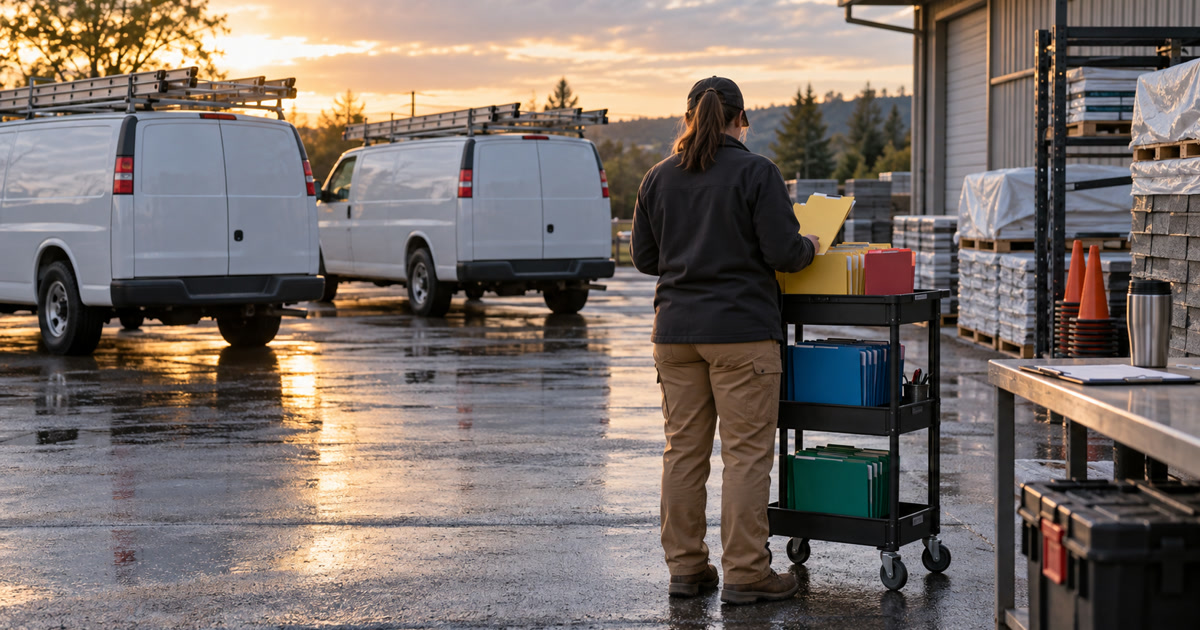
Clearly hypothetical scenario: A roofing contractor opens after a night of heavy weather. New requests mention leaks, missing shingles, insurance questions, scheduling, and fear that waiting will make things worse. The office needs order, but the support queue cannot become a substitute for an inspection, a safety decision, or insurance advice.
Trustworthy storm-call support sorts facts, preserves uncertainty, and sends decisions to people who can own them.
Short answer: Roofing contractors can use a customer support AI agent to organize routine storm-related inquiries, but the safe boundary is strict. The agent may collect basic request details, answer approved administrative questions, group messages, and pass context to the right person. It should not inspect a roof, estimate damage, interpret insurance coverage, promise response times, quote unapproved prices, or decide what is urgent. Build clear handoff rules for safety, technical, contract, and insurance questions. Keep a human owner for exceptions, and use current local warnings rather than a seasonal outlook to describe immediate conditions. The goal is a cleaner queue, not automated judgment.
A seasonal outlook is context, not a local lead forecast
NOAA’s August 6 update kept its forecast for below-normal Atlantic hurricane activity. The agency also says the outlook covers the full season through November 30 and is not a landfall forecast. Specific watches, warnings, tracks, and intensity forecasts come from the National Hurricane Center on a much shorter horizon.[1]
That distinction matters for roofing customer support. A seasonal headline should not become a sales script, a local damage assumption, or a reason to pressure a homeowner. Use current, location-specific public warnings for immediate conditions. Use the seasonal outlook only as planning context for staffing, scripts, and handoff readiness.
The FTC’s consumer guidance also warns people to be skeptical of contractors who promise immediate repairs after weather emergencies. It tells consumers not to rely on a contractor to say what insurance covers.[2] A trustworthy support process should make those boundaries obvious instead of hiding them behind polished automation.
What a roofing customer support AI agent can handle
KIGWI’s public Solutions page describes its Customer Support Agent as a first line for routine questions across chat, email, and a website, with human escalation when a conversation needs personal attention.[3] For a roofing contractor, a properly scoped workflow could support administrative tasks such as:
- collecting the caller’s basic contact information and stated reason for reaching out under the contractor’s approved privacy notice
- identifying whether the request concerns scheduling, an existing appointment, documentation, billing administration, or a new service inquiry
- answering only questions covered by the contractor’s approved service information
- grouping messages so the office can see duplicate requests and missing context
- routing technical, safety, pricing, contract, insurance, complaint, and unusual requests to the authorized person
- preserving the original wording so the human reviewer sees what the customer actually said
The agent should not inspect a roof from a description or photo, diagnose a problem, set repair scope, choose materials, make code or permit decisions, promise availability, interpret a policy, negotiate a claim, or make an emergency determination.
Build three support lanes, not one giant answer box
A useful support design separates requests by the kind of authority they need.
Lane 1: approved administrative answers
This lane covers information the roofing company has already reviewed and authorized. Examples can include office hours, service-area questions, what information to have ready, appointment-status questions, or where to send an approved document.
The answer should come from controlled source material. If the source is missing, outdated, or contradictory, the agent should stop and route the question rather than improvise.
Lane 2: human review with context
Some requests are administrative but still need judgment. A complaint, a rescheduling conflict, a request involving an existing contract, or a question the approved material does not answer should arrive with the customer’s words, the channel, the prior exchange, and the missing information clearly organized.
This is where a customer support AI agent earns its place. It reduces the sorting burden without pretending that routing is the same as resolving.
Lane 3: protected boundaries
Safety, inspection, technical scope, pricing, contracts, insurance, permits, warranties, and disputes need the qualified owner, contractor, insurer, counsel, or other responsible professional. The support agent should use the contractor’s approved handoff language and stop. It should not turn a boundary into an answer by adding a disclaimer and continuing anyway.
Generic chatbot versus a bounded customer support AI agent
| Question | Generic FAQ chatbot | Bounded customer support AI agent |
|---|---|---|
| What is it trying to do? | Return a likely answer | Complete a defined support step |
| What happens when information is missing? | May keep searching or generating | Stops and requests or routes the missing context |
| How are exceptions handled? | Often treated as another question | Sent to a named human owner |
| What does it do with technical or insurance questions? | Risk of producing a plausible answer | Refuses the decision and routes the original request |
| What should the team review? | Conversation logs after the fact | Exceptions and defined handoffs before action |
This is not a claim that every chatbot behaves badly or every agent behaves well. The difference comes from the workflow, source controls, permissions, and human review that are actually configured and tested.
Trust is built in the refusal rules
A roofing contractor does not need an AI agent that sounds certain. It needs one that knows which work belongs to the support queue and which work does not.
Useful refusal rules include:
- Do not describe local storm conditions from a seasonal outlook.
- Do not promise an inspection, arrival, repair, or callback time unless the approved schedule supports it.
- Do not estimate roof damage or suggest a repair scope.
- Do not tell a customer what insurance covers or what a claim is worth.
- Do not provide an unapproved price, discount, contract term, or financing statement.
- Do not hide a complaint, safety concern, or uncertain request inside a routine queue.
- Do not close an exception until an authorized person has reviewed it.
These rules are not a substitute for the contractor’s state and local requirements, approved scripts, or professional judgment. They are the guardrails that keep customer support administrative.
A practical review before launch
Before a roofing contractor uses any customer support AI agent, the team should review:
- the exact channels and request types included
- the approved source material for routine answers
- the information collected and the privacy notice shown
- the human owner for every exception category
- the stop conditions for safety, technical, insurance, contract, pricing, and complaint issues
- the test cases for ambiguous, incomplete, emotional, and duplicate requests
- the record of what the agent answered, routed, or refused
- the pause path when a source changes or the agent behaves unexpectedly
KIGWI is a fractional AI operations team. The work is to shape and operate bounded administrative workflows across the tools a small business already uses. The roofing team keeps authority over customer commitments, technical work, licensed decisions, and exceptions.
Frequently asked questions
Can a customer support AI agent inspect roof damage from a photo?
No. It may collect a photo through an approved, privacy-safe process and attach it to the service request, but it should not diagnose damage, choose a repair, estimate scope, or make a safety call. Those decisions belong to the roofing contractor’s qualified team under the rules that apply in the job’s location.
Can it answer insurance questions after a storm?
It can repeat approved administrative information, such as where a customer may send a document, but it should not interpret coverage, estimate a claim, negotiate with an insurer, or act as an adjuster. Insurance questions should go to the customer’s insurer or the appropriately authorized human, based on the contractor’s approved workflow.
Should every storm-related request be marked urgent?
No. A seasonal forecast or the word “storm” does not establish the condition of a property or the urgency of a request. The agent should preserve what the customer reports, follow the contractor’s approved escalation script, and send uncertain or safety-related situations to a qualified person rather than assigning its own risk level.
How is this different from an answering service?
An answering service can take messages and route calls. A bounded customer support AI agent can also group approved request details, answer controlled administrative questions, and prepare context for the next person. The better choice depends on the contractor’s channels, request types, review capacity, and need for human conversation. Neither should make roofing or insurance decisions.
What should a roofing contractor test first?
Start with a narrow set of repeat questions and exception cases using synthetic information. Check whether the agent quotes approved material accurately, preserves the customer’s wording, routes to the correct owner, refuses prohibited decisions, and stops when context is missing. Expand only after the team has observed reliable handoffs and can pause the workflow.
Next step
Review KIGWI’s Customer Support Agent scope. Compare it with the repeat questions your roofing team receives, then mark every inspection, safety, insurance, pricing, contract, and complaint question for human ownership.
Sources
[1] https://www.noaa.gov/news-release/noaa-maintains-prediction-for-below-normal-atlantic-hurricane-season – NOAA maintains prediction for below-normal Atlantic hurricane season [2] https://consumer.ftc.gov/articles/how-avoid-scams-after-weather-emergencies-and-natural-disasters – How To Avoid Scams After Weather Emergencies and Natural Disasters [3] https://kigwi.com/solutions – KIGWI Solutions