
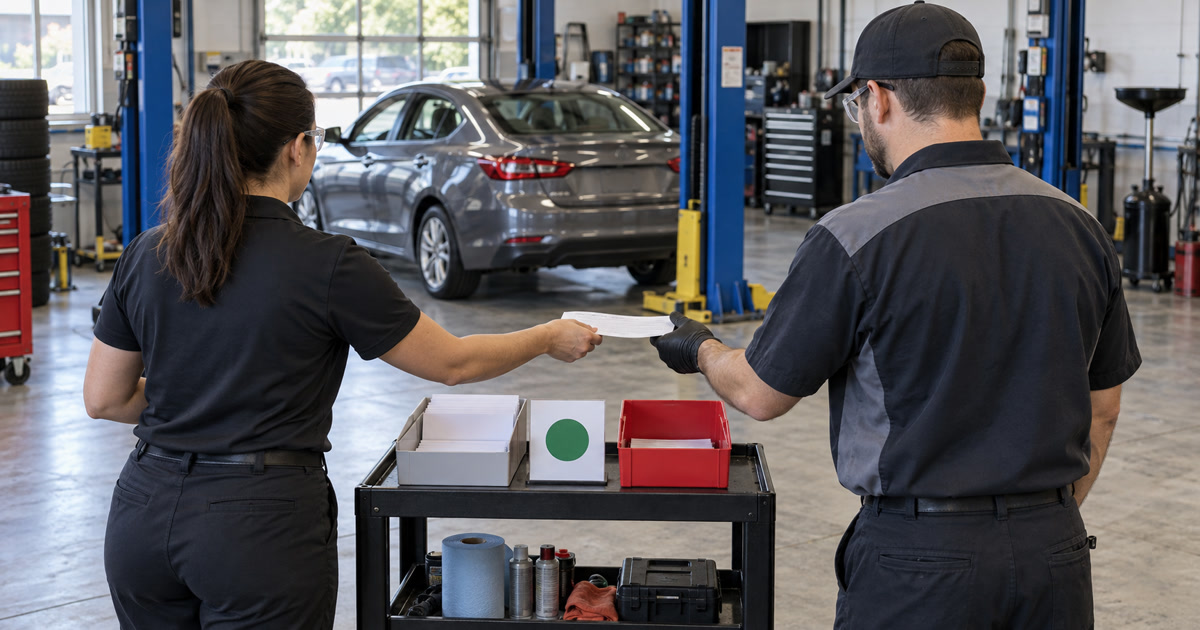
A service advisor needs an answer. A parts return is waiting. A customer approval has not reached the technician. If every loose end lands on the owner, the shop may have a staffing problem, a workflow problem, or both. AutoInc raised that exact decision-dependency issue on September 2, 2026: activity can be handed off while authority, judgment, and follow-up still stay with the owner.[1]
The useful hiring question is not “Can automation replace another employee?” It cannot replace human judgment. The better question is which recurring handoffs need a person and which need a clearer path.
Short answer: Workflow automation for auto repair shops fits repeatable administrative steps with clear inputs, rules, owners, and stop conditions. It can prepare a job packet, route a customer-approved status, flag an unresolved parts return, or assemble completion records for review. Hire a person when the work needs customer judgment, technical interpretation, changing priorities, coaching, or authority to make exceptions. The strongest design does both: it gives routine movement a defined path while keeping estimates, repair authorization, diagnosis, safety, pricing, and customer commitments with the shop’s responsible people.
What the current shop conversation gets right
The September AutoInc article argues that a team needs more than delegated activity. People also need clear authority, a defined finish line, and a review method.[1] That is useful whether a shop adds a person, changes a procedure, or introduces automation.
Current federal labor data adds context without deciding the answer for any individual business. The Bureau of Labor Statistics says automotive service technicians inspect, maintain, repair, document, and explain work. It projects continued demand for that skilled occupation through 2035.[3] Those are not throwaway duties. Workflow automation should protect technician and service-advisor judgment, not pretend to perform it.
Start with the work, not the tool
Before choosing software, a service, or another hire, map one recurring handoff:
- What starts the work?
- What information must be present?
- Who may approve the next step?
- What conditions stop the process?
- What record proves completion?
- Who owns an unresolved exception?
If those answers are missing, automation will move confusion faster. A new employee may absorb the confusion for a while, but the owner can still remain the final stop for every decision.
When a person is the better fit
Hire for work that depends on judgment, relationships, or changing shop conditions.
A person is the better fit when the role must:
- explain a repair recommendation or respond to a worried customer
- weigh technician capacity against changing priorities
- resolve a complaint or disputed charge
- coach employees and improve the process
- interpret incomplete information
- approve exceptions that affect price, timing, safety, or customer expectations
A person should also own any decision that state law, shop policy, professional competence, or customer trust puts in human hands. The FTC’s consumer guidance recommends written estimates, approval before work exceeds a stated limit, and completed repair orders, while noting that state requirements may apply.[2] KIGWI does not decide those requirements or authorize repair work.
When workflow automation is a credible fit
A bounded workflow is useful when the steps repeat and the rules are already approved.
| Recurring shop task | Possible administrative support | Human authority that stays in place |
|---|---|---|
| Job packet preparation | Gather approved fields and flag missing items | Service advisor confirms the record is ready |
| Customer-approval status | Route the recorded status to the assigned person | Authorized staff verify the approval and scope |
| Parts-return follow-up | Track an open item and surface the next review date | Staff resolve supplier terms, credits, and exceptions |
| Completion packet | Group approved work-order fields for review | Responsible staff confirm accuracy before customer use |
| Unusual request | Stop and route with context | Owner, manager, advisor, or technician decides |
The point is not to remove people. It is to stop routine status movement from competing with work that needs attention and authority.
KIGWI USA’s Custom AI Agent is the relevant offer when a business has one specialized, repeatable workflow that does not fit a standard role.[4] Any real setup still requires a verified process, approved tools, minimum necessary data, current permissions, testing, and human stop rules. No integration is assumed here.
Build the stop conditions first
A workflow should stop when:
- required information is missing or conflicts
- the customer’s request changes the job scope
- a price, estimate, timing, or warranty question needs a decision
- the status record does not match the current job
- a complaint or safety concern appears
- a supplier, technician, or customer exception falls outside the approved rules
- the system cannot prove what happened
A safe stop is not a failure. It is how the workflow keeps an administrative step from becoming an unauthorized decision.
How to test one workflow without automating the whole shop
Choose one recurring handoff that already causes rework. A parts return, missing job-packet field, or completion-record review can be easier to study than a customer-facing conversation.
Write the current steps down. Mark every decision, exception, data field, and owner. Then separate the work into three groups:
- repeatable preparation
- human decision
- unresolved exception
If the preparation step is stable and the handoff is clear, it may be a good workflow candidate. If the work changes every time or requires judgment at the first step, another person or a better human procedure is likely the stronger choice.
Five questions to ask before choosing
- Is the real constraint workload, unclear ownership, or missing authority?
- Which steps repeat without requiring technical or customer judgment?
- What evidence must exist before the next step can move?
- Which exceptions stop the workflow immediately?
- Would another person improve the work, or merely become the newest inbox for a broken handoff?
That last question matters. Hiring is the right answer when the shop needs human capacity and judgment. Workflow automation is the right answer only when the shop can define the work it wants moved.
Frequently asked questions
Can workflow automation replace a service advisor?
No. A service advisor handles customer context, changing priorities, explanations, exceptions, and commitments that require human authority. A bounded workflow may prepare information, route an approved status, or flag a missing step. It should not present itself as the person responsible for the customer relationship or the repair decision.
What is a good first workflow for an auto repair shop?
Start with a low-risk administrative handoff that repeats and already has an owner. Examples include flagging missing job-packet fields, tracking a parts-return review date, or grouping completion records for staff review. The right starting point depends on the shop’s actual process, tools, permissions, and exception rules.
Can automation approve repairs or estimates?
It should not make that decision. The workflow may carry a status that an authorized person has already verified, but it should not infer approval from silence, a partial message, or a changed job record. Repair authorization, estimate terms, and state-specific requirements remain with the shop and its qualified advisers.
When is hiring the better choice?
Hiring is stronger when the work needs judgment, customer care, technical understanding, coaching, live prioritization, or authority to handle exceptions. It is also the better choice when the process cannot be reduced to stable rules without losing important context. Automation is not a substitute for a role the shop genuinely needs.
How should a shop handle workflow exceptions?
Give each exception a named owner, a safe stop, and enough context to decide what happens next. The system should show what triggered the stop, what information is present, what remains unknown, and whether any action already occurred. Unknown outcomes should be investigated, not retried automatically.
Map one auto repair workflow before choosing a solution
Review the KIGWI Custom AI Agent, then map one recurring handoff using the questions above. Keep customer commitments, technical judgment, repair authorization, safety, and exceptions with the shop’s responsible people.
Sources
[1] AutoInc., “You Have a Team. Why Does Every Decision Still Need You?”, September 2, 2026. https://www.autoinc.org/you-have-a-team-why-does-every-decision-still-need-you/
[2] Federal Trade Commission, “Auto Repair Basics,” accessed September 19, 2026. https://consumer.ftc.gov/articles/0211-auto-repair-basics
[3] U.S. Bureau of Labor Statistics, “Automotive Service Technicians and Mechanics,” last modified August 27, 2026. https://www.bls.gov/ooh/installation-maintenance-and-repair/automotive-service-technicians-and-mechanics.htm
[4] KIGWI, “Solutions,” accessed September 19, 2026. https://kigwi.com/solutions/